
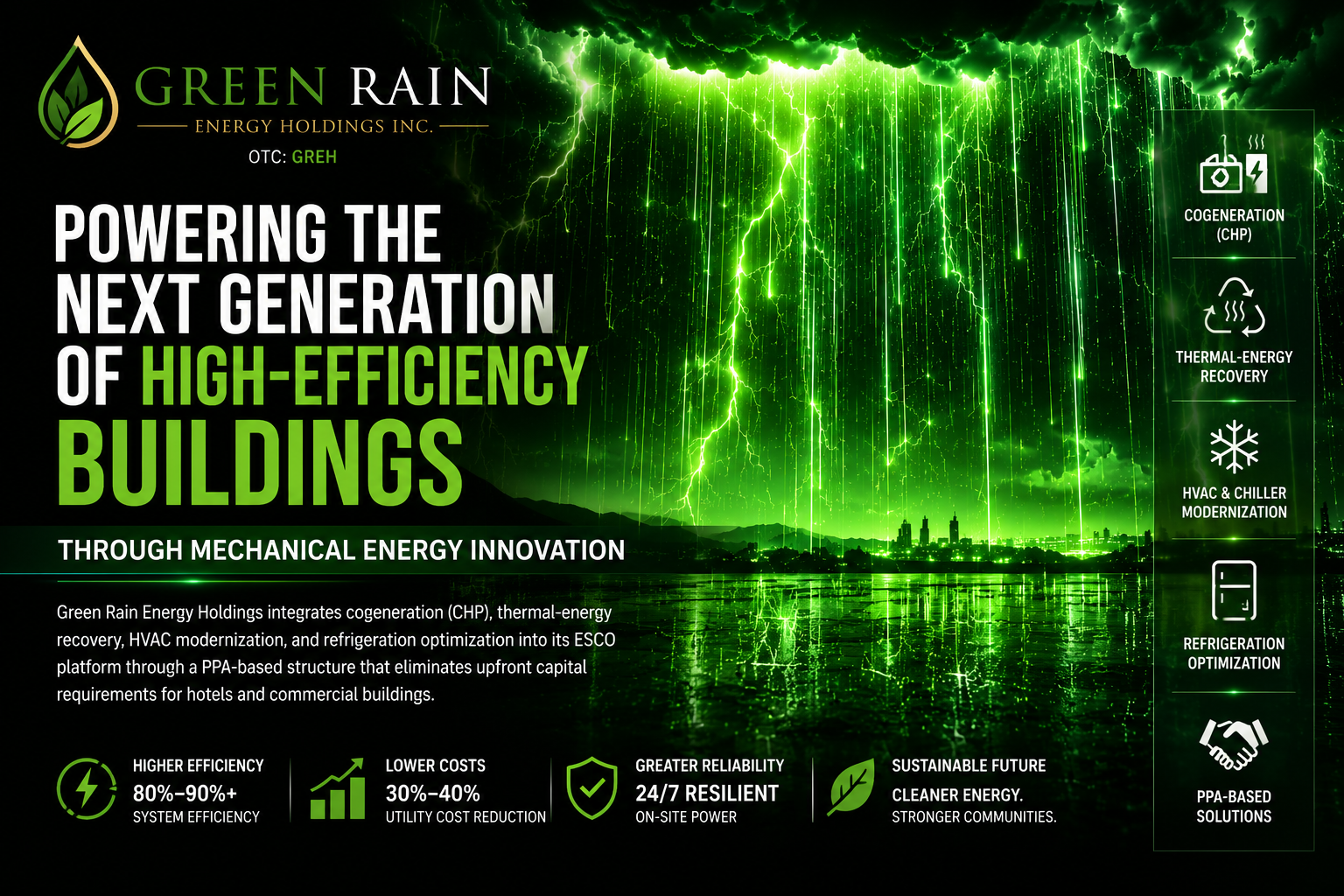
Green Rain Energy Holdings Inc. is expanding its energy infrastructure platform by working with mechanical engineering firms to identify, finance, and implement high-value opportunities in some of the most energy-intensive systems found in hotels, commercial buildings, refrigeration facilities, and other large properties.
The opportunity is significant: many commercial buildings continue to operate aging chillers, boilers, HVAC equipment, refrigeration systems, and conventional power infrastructure that consume substantial amounts of electricity and fuel. Modernizing these systems can create a powerful combination of lower operating costs, improved efficiency, greater reliability, and long-term predictable energy pricing.
Green Rain’s strategy is to combine these mechanical upgrades with its ESCO and Power Purchase Agreement (PPA) model, creating a capital-light approach that can allow property owners to modernize critical infrastructure without taking on the full upfront cost of the project.
Turning Aging Mechanical Systems Into Energy Assets
One of the largest opportunities is the replacement and modernization of aging chiller technology.
Chillers are among the largest energy consumers in many hotels, office buildings, hospitals, industrial facilities, and other commercial properties. Older equipment can operate substantially less efficiently than modern high-efficiency systems, particularly when combined with outdated controls, pumps, cooling towers, and HVAC infrastructure.
Working alongside qualified mechanical engineering firms, Green Rain can evaluate existing systems and identify opportunities to redesign, upgrade, or replace inefficient equipment.
The objective is not simply to install a new chiller.
It is to look at the entire mechanical-energy ecosystem.
That can include chillers, boilers, pumps, cooling towers, HVAC controls, refrigeration equipment, heat recovery systems, and on-site generation. By engineering these components to work together, a facility may be able to dramatically reduce wasted energy while improving comfort, reliability, and operational performance.
This creates what Green Rain views as a potentially explosive growth opportunity: turning outdated mechanical infrastructure into modern energy-producing and energy-saving assets.
Combined Heat and Power: Producing More From Every Unit of Fuel
A major component of this strategy is Combined Heat and Power, commonly known as CHP or cogeneration.
CHP technology simultaneously produces electricity and useful thermal energy at high efficiencies. Instead of generating electricity at a centralized power plant and allowing significant amounts of heat to be wasted, CHP systems can produce power directly at or near the facility where it is consumed.
The thermal energy that would otherwise be lost can be captured and used for facility requirements such as process heating, steam, hot water, or even chilled water through appropriate thermal-energy systems.
This creates a fundamentally different approach to energy management.
Rather than purchasing all electricity from the grid while separately purchasing fuel to produce heat, a properly engineered CHP system can allow one energy source to perform multiple jobs.
For large energy consumers, that can create a substantial economic advantage.
CHP systems can also provide an important reliability benefit. Because electricity is generated on-site, properly configured systems can provide resilient power during grid disruptions, subject to system design and applicable operating requirements.
CHP can also be integrated with other distributed-energy technologies, including solar photovoltaic systems and battery energy storage.
Green Rain’s ESCO + PPA Model
Green Rain’s opportunity becomes particularly interesting when these mechanical upgrades are combined with its ESCO platform and PPA-based financing structure.
Traditional building modernization often requires the property owner to make a substantial capital investment before any energy savings are realized.
For a hotel or commercial property, that can mean millions of dollars being allocated to equipment, engineering, construction, installation, and infrastructure upgrades.
Green Rain’s model is designed to change that equation.
Under a PPA-oriented structure, Green Rain can develop, finance, install, own, and maintain qualifying on-site energy infrastructure, allowing the customer to purchase energy services under a long-term contractual arrangement.
Instead of the property owner having to make the entire capital investment upfront, the project can be structured around long-term energy costs and expected savings.
This can potentially allow hotels and commercial buildings to modernize critical infrastructure while preserving capital for their core business.
From Chillers to Refrigeration Optimization
The opportunity extends beyond traditional HVAC.
Refrigeration can represent a major energy expense for supermarkets, food-service operations, hotels, cold-storage facilities, and other commercial properties.
Green Rain’s integrated mechanical-energy approach can incorporate refrigeration optimization alongside HVAC modernization, thermal-energy recovery, chillers, boilers, controls, and on-site generation.
The goal is to identify where energy is being consumed, where energy is being wasted, and where different systems can be integrated to capture additional value.
For example, waste heat generated by one system may potentially become a useful energy resource for another portion of the facility.
That is the fundamental principle behind thermal-energy recovery: energy that was previously treated as waste can potentially become a productive asset.
The Economics of Energy Efficiency
When properly engineered and implemented, high-efficiency cogeneration and mechanical-energy systems can achieve very high overall efficiencies because electricity and useful thermal energy are produced from the same energy input.
Project economics will vary significantly based on building size, existing equipment, utility rates, operating schedules, fuel costs, equipment selection, financing terms, and local conditions.
However, Green Rain’s objective is to pursue projects where the combination of energy efficiency, on-site generation, thermal recovery, and optimized mechanical systems can produce meaningful reductions in total energy expenditures.
Potential savings from comprehensive projects can be substantial, with the company’s strategy targeting opportunities that may reduce total energy costs while improving equipment performance and reliability.
For property owners, the value proposition is therefore larger than simply “buy newer equipment.”
It becomes:
Modernize the building. Reduce energy waste. Improve reliability. Avoid major upfront capital expenditures. And create a predictable long-term energy-cost structure.
A Full-Spectrum Infrastructure Platform
Green Rain’s mechanical-energy strategy also expands the company’s potential addressable market.
The company can position its ESCO platform around multiple infrastructure categories rather than relying on a single technology.
That can include:
- Combined Heat and Power (CHP)
- High-efficiency chillers
- Advanced boiler systems
- HVAC modernization
- Thermal-energy recovery
- Refrigeration optimization
- Energy-management controls
- Solar photovoltaic systems
- EV charging infrastructure
- Energy storage
- On-site power generation
This integrated approach is particularly relevant to hotels and large commercial properties, where electricity, heating, cooling, refrigeration, and other mechanical systems represent interconnected components of the property’s overall energy profile.
Building the Future Through Engineering Partnerships
Mechanical engineering firms can play a critical role in this strategy.
Their expertise can help evaluate existing infrastructure, identify modernization opportunities, engineer system configurations, estimate energy performance, and develop implementation plans.
Green Rain can then potentially bring financing, project development, ownership, maintenance, and long-term energy contracting capabilities to those opportunities.
The result is a partnership-oriented model in which engineering expertise and energy infrastructure financing come together.
For property owners, the objective is simple: make the building operate better without requiring the owner to become an energy-infrastructure company.
The Bigger Opportunity
The future of commercial energy is increasingly moving toward distributed generation, efficiency, electrification, thermal-energy recovery, resilient infrastructure, and intelligent energy management.
Green Rain Energy Holdings is positioning its ESCO platform to participate in that transition.
By combining mechanical engineering, CHP technology, HVAC and chiller modernization, refrigeration optimization, thermal-energy recovery, and PPA-based financing, Green Rain seeks to transform aging building infrastructure into modern, high-efficiency energy assets.
The opportunity is not limited to saving electricity.
It is about reengineering how buildings produce, purchase, distribute, and consume energy.
For hotels and commercial properties facing aging infrastructure, rising utility costs, and pressure to modernize, that could represent a compelling path toward greater efficiency and resilience.
And for Green Rain, expanding into mechanical energy and cogeneration could create another significant growth engine—one capable of complementing its existing energy-efficiency and EV infrastructure initiatives while establishing the company as a full-spectrum energy infrastructure and ESCO platform.